Guide
Warm transfer vs cold transfer: which to use
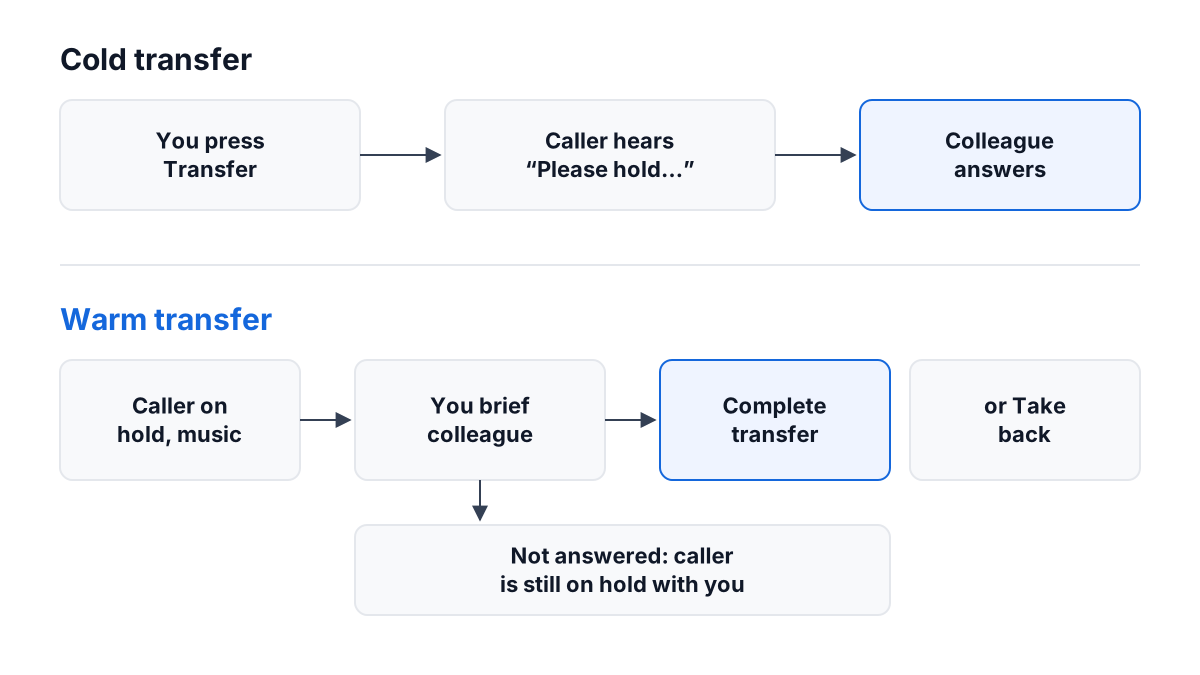
Most small teams transfer calls the same way every time, whatever the call is about. That is fine for half of them and wrong for the other half. There are two ways to pass a caller on, and the choice between them is the difference between a caller who feels looked after and one who has to tell their story twice.
The two kinds of transfer, in one sentence each
A cold transfer (also called a blind transfer) sends the caller straight to a colleague or a group, with no introduction. You press transfer, and you are free for your next call.
A warm transfer has you speak to the colleague first, while the caller waits on hold, and then join the caller to them. Your colleague picks up already knowing who is calling and why.
Neither is better in general. Each is better for a particular kind of call.
When a cold transfer is the right call
Use a cold transfer when the caller has not told you anything the next person needs to hear. That is most routing calls:
- “Can I speak to someone in billing?”
- “I need to book a visit.”
- “Is Sam there?”
The caller has asked for a place, not explained a problem. Briefing your colleague would only add a minute of hold for no gain. Send them on, and say where they are going: “I’m putting you through to our billing team now.”
A cold transfer is also the right choice when the person you want is busy. If they are on another call, a warm transfer has no one to talk to. Sending the caller to that person’s voicemail, with a word of warning first, is more honest than leaving them on hold in hope.
When a warm transfer is worth the extra minute
Use a warm transfer when the caller has already explained something they should not have to repeat. Signs that a call needs one:
- The caller has spent more than a minute or two describing the problem.
- They are upset, or they have called before about the same thing.
- The question is one only a particular person can answer, such as a refund, a contract, or a complaint.
- You are not sure the colleague can help, and you want to check before you hand the caller over.
The cost is a short wait for the caller. The return is that your colleague opens with “Hi, I hear the invoice from last month was charged twice,” not “How can I help?”
A simple rule for a small team: if the caller has told you a story, introduce them. If they have only asked for a door, open it.
What the caller hears while you talk to your colleague
This part decides whether a warm transfer feels good or awful.
- Put the caller on hold before you talk. They should not hear you describe them. A short, kind sentence first helps: “Let me check with Dana, who looks after refunds. I’ll put you on hold for a moment.”
- Play hold music, not silence. Silence sounds like a dropped call, and people hang up on it. Music tells them the line is still open.
- Keep the briefing short. Who is calling, what they want, and what you have already tried. Thirty seconds is plenty.
- Come back to the caller if it runs long. If your colleague needs a minute to find something, take the caller off hold and say so. A caller who has been told why they are waiting will wait longer than one who has not.
When the colleague is ready, join them and leave. Some teams like to stay on the line for a three-way introduction. That works if your phone system supports it, but it is not required: the colleague already knows the story, so they can greet the caller by name themselves.
What happens if the colleague does not answer
Plan for this before it happens, because it will.
On a warm transfer, the caller is still with you while the colleague rings. If no one answers, nothing is lost:
- Take the caller off hold.
- Say what happened in plain words: “Dana isn’t free at the moment.”
- Offer a choice: a callback from Dana today, a message in her voicemail, or help from someone else.
Do not quietly send the caller to voicemail after a failed warm transfer without telling them. They agreed to wait for a person.
On a cold transfer, the caller has already left you. If the colleague does not answer, they usually land in that person’s voicemail. That is acceptable for a simple routing call, but someone has to know about it. The best setups tell the person who transferred the call that it was not answered, so the caller is not forgotten.
A worked example
A seven-person company sells booking software to salons. One morning, two calls come in a few minutes apart. Leo, on the support line, answers both.
Call one: a refund (warm)
The first caller, Mia, runs a salon that was charged twice for its yearly plan. She has already spent three minutes explaining it to Leo, including which card was used and when she noticed. She is calm but tired.
Leo cannot issue refunds. Dana owns Mia’s account and can. This is a story, not a door, so Leo uses a warm transfer:
- Leo says, “Dana looks after your account and can sort this out. I’ll put you on hold for a moment while I tell her what happened.”
- Mia is on hold and hears music.
- Leo rings Dana. She answers. Leo says, “Mia from the salon on Bridge Street was charged twice for the yearly plan, both on the 3rd, same card. She wants one refunded.”
- Dana says she can see it and is ready.
- Leo completes the transfer and leaves the call. Dana greets Mia by name and starts with the refund, not with questions.
Had Dana not answered, Leo would have taken Mia off hold, told her Dana was busy, and offered a callback before noon.
Call two: a billing address (cold)
The second caller, Theo, only wants to know which address to put on a purchase order. That is a question for the bookkeeping team, and Theo has told Leo nothing they need to hear.
Leo says, “I’ll put you through to our billing team,” and sends the call straight to the billing group. Whoever is free there picks up. Leo is free for the next call.
Two calls, two transfers, each about thirty seconds of Leo’s time, and no one repeated themselves.
A short checklist for your team
| Question | If yes |
|---|---|
| Has the caller explained a problem in detail? | Warm |
| Is the caller upset, or calling back about the same thing? | Warm |
| Did they only ask for a team or a person by name? | Cold |
| Is the person you want on another call? | Cold, to their voicemail, after warning the caller |
| Are you unsure whether the colleague can help? | Warm, so you can check first |
Agree on this as a team, and write it where new people will find it. Transfers are one of the few moments a caller sees how well the people inside a business talk to each other.
If calls in your team also ring several people at once, the way that group rings matters as much as how you transfer into it. What is a ring group, and how should it ring? covers that. And if a caller usually wants the person who looks after their account, you can often skip the transfer altogether: How to route calls to the customer’s account owner explains how.
How ContactRoll does it
In ContactRoll, calls ring in the browser through your own Twilio account, and both kinds of transfer are on the call controls. Transfer to [name] is a cold transfer to a member or a call group: the caller hears “Please hold while I transfer you.” and you are free right away. If no one takes the call, you get a task saying so. Talk to [name] first is the warm transfer, on the Plus plan: the caller is put on hold with your organization’s hold music and cannot hear you, your colleague’s browser rings for 25 seconds with your note on their screen, and you then press Complete transfer or Take back. If no one answers, the caller simply stays on hold with you. See calling in ContactRoll.
Questions
What is the difference between a warm and a cold transfer?
A cold (or blind) transfer sends the caller to a colleague with no introduction. A warm transfer puts the caller on hold while you speak to the colleague first, then joins the caller to them.
What does the caller hear during a warm transfer?
They should hear hold music, not silence, and they should not hear you and your colleague talking. When you come back, tell them who they are about to speak to.
What happens if the colleague does not answer a warm transfer?
The caller is still on hold with you. Take them off hold, say plainly that your colleague is not free, and offer a callback or a cold transfer to their voicemail.