Guide
Using your own Twilio account for business calls
Some phone tools, CRMs among them, can work with a Twilio account you own instead of selling you minutes of their own. Twilio rents out phone numbers and carries calls for the software that asks it to. The tool decides who rings, what callers hear and where each call is written down; Twilio does the phone part and sends you the bill.
This guide covers what that means, why a small team might want it, what to set up before the first call, and what a month costs at Twilio’s published prices. It works whichever tool you connect, and every Twilio page it links to was read on October 10 or 11, 2026.
What it means to bring your own Twilio account
The work splits in two:
| The phone tool | Twilio, in your account |
|---|---|
| Places and answers calls | Carries each call over the phone network |
| Decides who rings and what callers hear | Holds your phone numbers |
| Writes each call onto the customer’s record | Makes and stores any recordings |
| Shows the team what is ringing | Bills your account for every number and minute |
The tool works inside your Twilio account with a key you give it, and it can do only what that key allows. Twilio bills you directly.
Why a small team might want it
One bill for calls, at Twilio’s published prices. Calls are billed by Twilio, at the prices on its own price list, whichever tool placed them.
Numbers you keep. The numbers belong to your Twilio account, not to the tool. If you change tools, you point the same numbers at the new one, and customers keep calling the numbers they know.
Recordings in your own account. Twilio keeps the recordings it makes in your account and charges each month to store them, so the audio stays with you if you change tools.
What it asks of you. It is a second account to look after: a prepaid balance, its own taxes and a few settings that are yours to get right. Most of that is the setup below, done once.
What to set up at Twilio before the first call
Do these four things in Twilio’s console.
- Upgrade to a full account. A trial account can call only numbers you have verified, up to five of them (Twilio’s free trial). Upgrading asks for your legal name and phone number, sometimes a government ID, your address, which Twilio uses for taxes, a payment method and a first balance, and it makes a customer profile along the way (upgrading to a paid account). Switch on automatic recharge while you are there: it is optional, but without it an account whose balance reaches zero risks suspension.
- Buy a number that takes voice calls, local or toll-free; their prices are below. In some countries, Twilio may ask for a compliance profile, which it calls a regulatory bundle, before it sells you a number there.
- Turn on the countries you call. Twilio’s voice geographic permissions decide which countries your account may dial, and Twilio refuses a call to a country that is not turned on, your own included (geographic permissions). Turn on only the countries you call.
- Make a Standard API key for the tool, not a Main key, which can do more than a phone tool needs (API keys). Make one key for each tool, so you can delete it alone if you change tools. Twilio shows the key’s secret only once, so paste it into the tool straight away.
The tool then asks for three things: the account’s SID, the key’s SID and the key’s secret. Some tools also ask for the account’s Auth Token, for one narrow job: Twilio signs every request it sends with that token, and the token is how a tool checks that a request really came from Twilio (Twilio’s webhook security). The Auth Token opens the whole account, so give it only to a tool that says what it uses it for.
Before the first day, run Twilio’s network test on each computer that will take calls. Calls in the browser travel on WebRTC, and a browser extension that blocks it stops calls from connecting.
What it costs, line by line
These are Twilio’s US prices from its voice pricing page, read on October 11, 2026. The page says “Pricing current as of August 2026”, and the prices are before taxes and before any volume discount.
| What you pay for | Twilio’s price |
|---|---|
| A local number | $1.15 a month |
| Receiving a call on a local number | $0.0085 a minute |
| Making a call to a US or Canadian number | $0.0140 a minute |
| The browser’s side of a call | $0.0040 a minute |
| Recording a call | $0.0025 a minute |
| Keeping a recording | $0.0005 a minute, each month |
A toll-free number costs $2.15 a month and $0.0220 a minute to receive, and calls to Alaska cost $0.0945 a minute. Four rules turn the table into a bill:
- A call in the browser is two calls. Twilio bills one leg between Twilio and the browser and another between Twilio and the other phone (Voice SDK pricing). A minute answered in the browser costs $0.0085 plus $0.0040, or $0.0125, and a minute placed from the browser costs $0.0140 plus $0.0040, or $0.0180.
- Every leg is rounded up to the whole minute. Each leg is billed on its own, so a call of 2 minutes and 10 seconds is billed as 3 minutes on each leg (how Twilio bills each leg).
- Callers are on the meter before anyone answers. A call that only hears a greeting or a menu is one leg, billed at the receiving rate, and a caller waiting in line is billed for every minute of the wait. A short phone menu and a short closed message after hours keep those minutes down.
- A recording is paid for twice. You pay once to make it and again for every month it is kept. How long you keep recordings sets that second line.
A worked example: a six-person repair business
Larkspindle Appliance Repair is invented. Six people work there: Mirela, who owns it, Teodor and Bea at the front desk, and three technicians out on jobs. Customers call one local number to book repairs, and the front desk calls them back to confirm visits and parts. Mirela, Teodor and Bea take calls in the browser, in a ring group that rings whoever is free.
In a typical month about 1,500 minutes of calls come in and 500 go out, counted as Twilio bills them. Every call is taken or placed in the browser. For the estimate, half the minutes, 1,000, are recorded, and recordings are kept for 90 days.
| Line | Count × price | A month |
|---|---|---|
| One local number | 1 × $1.15 | $1.15 |
| Calls received | 1,500 × $0.0085 | $12.75 |
| Calls made to US numbers | 500 × $0.0140 | $7.00 |
| The browser’s side of every call | 2,000 × $0.0040 | $8.00 |
| Recording | 1,000 × $0.0025 | $2.50 |
| Keeping 90 days of recordings | 3,000 × $0.0005 | $1.50 |
| Total, before taxes and surcharges | $32.90 |
The storage line grows for three months as recordings build up, then holds at about 3,000 minutes as the oldest are deleted. So Larkspindle’s calls come to about $33 a month before taxes, a little over 1.6 cents for each of its 2,000 minutes. Recording every minute instead of half would add $4.00: $2.50 to record and $1.50 to keep.
What the estimate leaves out:
- Taxes. Twilio charges taxes based on the address you give it when you upgrade.
- Surcharges. In a month with many very short or unanswered calls, Twilio may add a surcharge; see below.
- Extras. A greeting read in one of Twilio’s premium voices costs from $0.0008 per 100 characters, where its free voice costs nothing, and some tools move a held or transferred call into a Twilio conference, from $0.0018 a participant per minute.
- The phone tool’s own price. The software is billed apart from the calls.
What to watch
The balance. Without automatic recharge, an account whose balance reaches zero risks suspension, so keep automatic recharge on, with room for taxes.
The calls you place. Set a monthly cap on minutes for calls you place, where your tool offers one, so a mistake or a misused key cannot run up a bill, and keep the geographic permissions to the countries you call. Calls that come in are your customers, so watch them rather than cap them.
Short and unanswered calls. Twilio’s terms for calls to North American numbers let it charge $0.015 for each short or unanswered call in a month when 20% or more of the calls you place last six seconds or less, or 20% or more go unanswered. It may also charge $0.01 a minute when the calls you place average under 30 seconds. A team working a long list of leads should check its numbers.
Recording announcements. Recording laws differ from place to place, and announcing every recorded call before it starts is the simple habit. Telling callers a call is recorded has wording to use and how long to keep recordings.
How ContactRoll does it
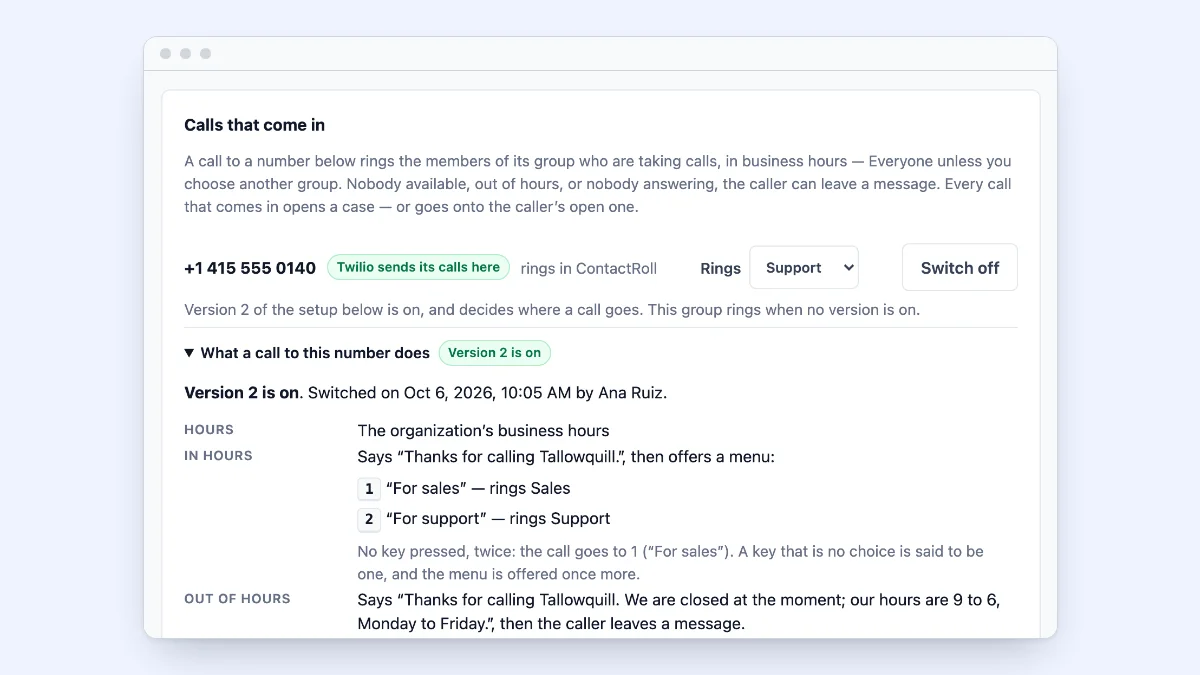
In ContactRoll, calls are placed and answered in the browser through your organization’s own Twilio account. It connects with a Standard API key you create, makes one thing in your Twilio account, a TwiML App, and points the numbers you choose at it. Twilio bills your own account for every call and number, with no markup from ContactRoll, and the calling settings show what the month’s calls come to at Twilio’s published prices for US and Canadian numbers. Recording is off until an Owner or Administrator switches it on, every recorded call is announced, and the audio stays in your Twilio account. Calls placed from ContactRoll stop at a monthly cap of minutes your administrator sets; calls that come in are never cut off, and your administrators are told when they pass it. If you also give it the account’s Auth Token, it is kept sealed and used only to check that each request from Twilio really is Twilio’s. Each number’s setup decides what callers hear in business hours and after them: a greeting first, then a call group, voicemail or, on Plus, a phone menu. ContactRoll’s plans are on the pricing page. You can start free, with no card.
Questions
Can I use my own Twilio account with a CRM?
Yes, if the CRM offers it. The CRM places and answers the calls, Twilio carries them and bills your own account at its published prices, and your numbers and recordings stay in that account.
How much does a Twilio business phone line cost?
At Twilio’s US prices read on October 11, 2026, a local number is $1.15 a month, receiving a call costs $0.0085 a minute and calling a US number $0.0140 a minute, plus $0.0040 a minute for the browser’s side of a call. A six-person team with 2,000 minutes a month, half of them recorded, comes to about $33 before taxes and surcharges.
Do I need a paid Twilio account for business calls?
Yes. A trial account can call only numbers you have verified, up to five of them, as Twilio’s trial page described it on October 11, 2026. Upgrading to a paid account removes the trial’s limits.