Guide
How to route calls to the customer’s account owner
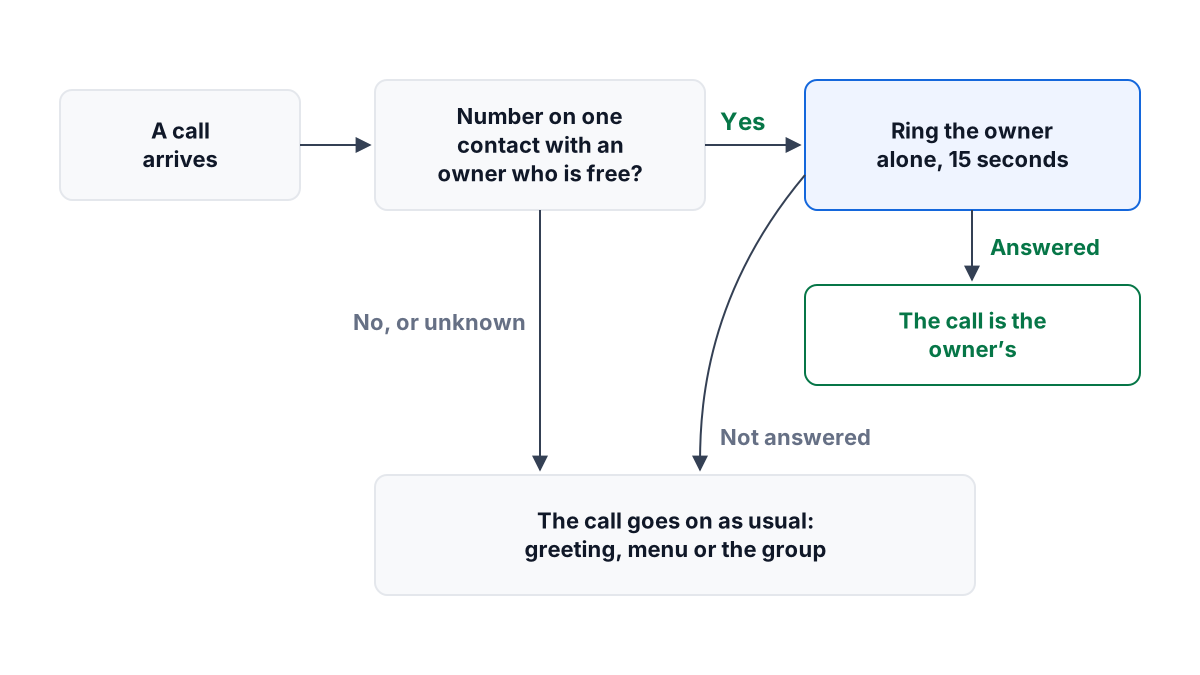
Customers who have one person they deal with would rather reach that person. They do not want to explain to whoever happens to pick up that they spoke to Nora last week about the server migration. Routing calls to the account owner, sometimes called sticky routing, sends a known caller to their person first, and to everyone else only if that person is not there.
Done well, it is invisible to the caller. Done badly, it adds a long silence before anyone answers. This guide covers how to do it well, in any phone system that supports it.
The idea in one paragraph
When a call arrives, the phone system looks up the number calling. If it belongs to a customer who has an account owner, it rings that owner alone, for a few seconds. If the owner answers, the call is theirs. If not, the call goes on exactly as it would have without the rule: the greeting, the menu, or the group that usually answers. Unknown callers skip the first step entirely.
Step 1: make sure callers can be recognized
Owner routing is only as good as the phone numbers on your contacts. A caller is recognized by their number, so:
- Save the number people actually call from. Often that is a mobile, not the office line in their email signature.
- Keep one number on one contact. If two contacts share a number, such as a front desk, the system cannot tell which of them is calling. It should not guess. Treat a shared number as unknown and let the call go to the group.
- Do not route on a company’s main number. Several people at a client call from the same switchboard, and they may have different owners, or none.
Spend an hour on your most important customers first. The routing rule helps only the callers whose numbers are on file.
Step 2: give every important customer an owner
The rule needs a person to ring. Decide who owns each account, and write it on the contact. A few habits help:
- One owner per customer, not a shared mailbox name.
- New customers get an owner when they become customers, not months later.
- When someone leaves the team, move their customers to someone else the same week. A call routed to a person who has gone is a call that waits for nothing.
Customers who call once and never again do not need an owner. They will go to the group, which is right.
Step 3: decide what happens when the owner is busy or away
This is where most of the design is.
The owner is on another call. Do not ring them. They cannot answer, and the caller would wait for nothing. Go straight to the group.
The owner is not working today. Same answer. If your phone system knows who is available, it should skip anyone who is not. If it does not, owner routing during holidays becomes a delay for every one of that owner’s customers.
The owner is free but does not answer. Ring them for a short time, then fall back. They may be away from their desk for a minute; the group can help.
The office is closed. If the call would go to a closed message or voicemail anyway, ringing the owner first adds nothing. Let the after-hours setup decide. Handling calls after hours covers what that setup should be.
The rule is simple: ring the owner only when they could plausibly answer, and only when the call would otherwise ring a person.
Step 4: keep the wait short
The owner’s ring happens before anything else. The caller hears ringing, or silence, while it lasts. If the owner does not answer, the caller then hears the greeting or rings the group from the start. So every second of the owner’s ring is a second added to the wait of every caller whose owner is not there.
Ten to twenty seconds is usually enough. A person sitting at their desk answers in a few rings. Someone who has not answered in fifteen seconds is not about to.
Think of it this way: a long owner ring makes the callers who matter most wait the longest, on exactly the days their owner is busy.
Step 5: tell the owner why their phone is ringing
When an owner picks up a call routed to them, it helps to see who it is before saying hello: the customer’s name and a note that this call came to them because they own the account. They can greet the caller by name, and they will not mistake it for a call meant for the whole team.
It also helps to see afterwards what happened to the routing. Did the owner answer? Did the call fall back to the group? If owners miss most of their routed calls, the setup is adding delay without benefit, and it is time to look at who owns what.
A worked example
A twelve-person IT support firm looks after about sixty small offices. Each office has one account manager. Most calls go to the support group, five people who ring at once.
The firm sets up owner routing like this:
- Each client contact’s mobile and direct line are saved on their contact, one number per person.
- Each contact has an owner: their account manager.
- When a call arrives in business hours, a caller whose number belongs to one contact rings that contact’s owner alone for 15 seconds.
- If the owner is on a call or not taking calls, that step is skipped.
- If the owner does not answer, the call goes to the support group as usual.
A known caller
Omar, office manager at a dental practice the firm looks after, calls from his mobile, 555-0142. His number is on his contact, and his account manager is Nora.
Nora is free, so her browser rings alone, showing Omar’s name and that he is her contact. She is in the kitchen and does not answer. After 15 seconds the call goes on to the support group. Ivan picks up, sees Omar’s name and his practice, and helps with the printer. Later, Nora sees on Omar’s timeline that she was rung first and that Ivan took the call.
The next week Omar calls again, Nora is at her desk, and she answers on the second ring.
An unknown caller
A woman calls from 555-0187, a number no one at the firm has saved. There is no contact and no owner, so there is nothing to ring first. The call goes straight to the support group with no delay.
A shared number
The reception desk of another client calls from its main line, which is saved on three contacts. The system cannot tell which of the three is calling, so it rings no one first and the call goes to the group.
Common mistakes
| Mistake | What it costs | Fix |
|---|---|---|
| Ringing the owner for 45 seconds or more | Callers wait before anyone else is tried | Keep it to 10–20 seconds |
| Ringing an owner who is on a call | Pure delay | Skip owners who are busy |
| Owners left on contacts after people leave | Calls ring no one first, then fall back late | Reassign customers the week someone leaves |
| Routing on a shared or company number | The wrong person is rung | Only route numbers that belong to one contact |
| Ringing the owner when the office is closed | A delay before the closed message | Let the after-hours setup decide first |
Owner routing pairs well with a good fallback. If the group behind it rings everyone at once or one at a time, What is a ring group, and how should it ring? explains the choice. And when a call reaches the wrong person anyway, Warm transfer vs cold transfer covers passing it on.
How ContactRoll does it
In ContactRoll this is owner-first ringing, part of a number’s setup on the Plus plan. Tick Ring the caller’s owner first and choose 5 to 30 seconds (it starts at 15). A call from a number that belongs to exactly one contact rings that contact’s owner alone, when they are taking calls in the browser and not on a call, and only where the setup would ring a group or offer a menu. If the owner does not answer, the call goes on as set up, from the start. A shared number, a company’s number or an unknown number goes straight to what is set up. When the owner’s browser rings, it shows that the call came to them first, and the call’s entry says what happened. See calling in ContactRoll.
Questions
What is account owner routing?
Also called sticky routing, it rings the person who owns a caller’s account first, for a few seconds, before the usual group. If they do not answer, the call carries on exactly as it would have.
How does the phone system know who is calling?
It matches the number calling against the phone numbers saved on your contacts. A number that belongs to exactly one contact with an owner can be routed to that owner.
How long should the owner be rung before the call falls back?
Short: ten to twenty seconds is enough for someone at their desk to answer. Every extra second is a second the caller waits before anyone else is tried.