Guide
Telling callers a call is recorded
This is not legal advice. Recording laws differ from state to state and from country to country, and they change. What follows is a practical habit for a small team, not a statement of what the law requires where you are. If you record calls, check the rules that apply to you and the people you call, and ask a lawyer if you are unsure.
With that said, most of what makes recording safe and useful is not legal at all. It is a short sentence at the start of the call, a short list of who may listen, and a date on which recordings are deleted.
Why the rules are hard to pin down
In the United States, the federal wiretap law allows a person to record a call they are part of, or one where a party has consented, with some exceptions. You can read the text at 18 U.S.C. § 2511(2)(d), on Cornell Law School’s Legal Information Institute. People call this “one-party consent”.
States can set stricter rules, and several do: some require the consent of everyone on the call, which people often call “two-party” or “all-party” consent. The Digital Media Law Project’s guide to recording phone calls and conversations, written at Harvard’s Berkman Klein Center, gives a general overview and names the states it counted as requiring everyone’s consent. That project says it is no longer being updated, so treat it as a starting point and check the current law of any state that matters to you.
The same guide makes a point that matters for any business with customers in more than one place: when the people on a call are in different states, it is hard to know in advance which law applies, and it advises getting the consent of every party to be safe. Outside the US, the rules are different again.
A small business rarely knows where every caller is sitting. That is the practical case for one simple habit.
The simple habit: announce every recorded call
If every recorded call starts with an announcement, every caller has been told before the conversation begins. A caller who does not want to be recorded can say so, or hang up. Whether an announcement on its own is enough consent where you are is a legal question for you, but it is the common starting point, and it costs nothing.
Good announcements share three things:
- They come first. Before the caller explains anything, and before your colleague says hello.
- They are short. One sentence. Callers stop listening after the second.
- They are the same every time. No call should be recorded without it, including transferred calls and calls you place.
Announcement wording you can use
Pick one and use it everywhere.
- “This call is being recorded.”
- “This call is recorded for training and for our records.”
- “Calls are recorded so we can check what was agreed.”
- For calls you place: “Before we start, I’ll mention this call is being recorded.”
If your phone system plays the sentence automatically, you never depend on a busy person remembering it. If it does not, put the sentence at the top of whatever script your team uses, and check a few calls each month to see it was said.
Some teams also mention recording in their phone menu’s greeting, or on their website’s contact page. That is a nice extra, but it does not replace saying it on the call itself: a caller transferred straight to a person never hears the menu. If you are writing a menu, How to set up a phone menu covers greetings.
Three calls teams forget to announce
The announcement tends to slip on the calls that do not start the usual way:
- Calls you place. The person you call did not choose to ring a business, so they are even less likely to expect a recording. Announce before you start talking about anything else.
- Transferred calls. If the caller heard the announcement when the call began, they have been told. Avoid recording the part where they wait on hold, and do not record private talk between colleagues while the caller waits.
- Voicemail. A message a caller leaves is itself a recording. Treat voicemails like any other recording: the same people may listen, and the same keep period applies.
Where recordings are kept, and who can listen
A recording of a customer call is personal information about that customer. Treat it the way you treat their emails.
Keep recordings in one place. Not in personal downloads folders, not attached to emails. One place means one place to search, one place to protect, and one place to delete from.
Decide who may listen. For most small teams:
| Who | Listen | Download | Delete |
|---|---|---|---|
| Owner or office manager | Yes | Only if there is a reason | Yes |
| People who take calls | Yes, for their own work | No | No |
| Everyone else | No | No | No |
Know who listened. If a customer ever asks who heard their call, you should be able to answer. A list of who played each recording, and when, is enough.
Be careful with downloads. A downloaded file is a copy you no longer control. Deleting the original does not delete the copy. Many teams leave downloads off unless someone has a specific need.
How long to keep recordings
Keep a recording as long as you have a reason to, and no longer. Typical reasons are checking what was agreed, training, and handling a complaint. Most of those are settled within weeks.
A sensible approach:
- Pick a period: 30, 90 or 180 days, or a year.
- Write it down, in the same place as your announcement wording.
- Have recordings deleted automatically when it runs out, so no one has to remember.
- When a customer asks you to delete their information, delete their recordings too.
If a particular recording must be kept longer, for example because of a dispute, make that an exception someone decides on, not the default.
Keeping recordings can also cost money: Twilio, for one, charges each month for every minute of recording an account keeps. A short keep period saves a little each month as well.
A worked example
A five-person insurance agency decides to record calls. Rosa, the office manager, sets it up over one afternoon.
- The announcement. Every answered call, and every call the agency places, starts with “This call is being recorded.” The phone system plays it, so no one on the team has to say it.
- Who listens. The four agents can listen to calls. Rosa and the owner, Ken, can see who listened. Downloads stay off.
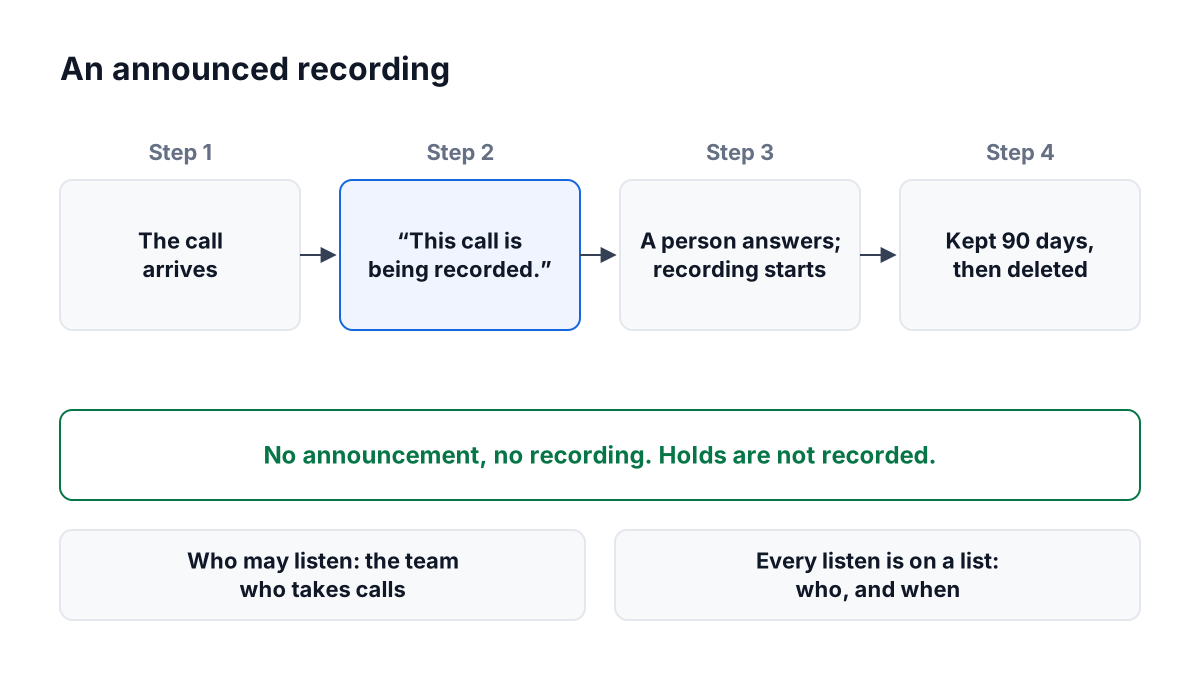
- The keep period. Rosa chooses 90 days. Recordings older than that are deleted automatically.
- The written note. Rosa adds three lines to the team’s handbook: the announcement, who may listen, and the 90 days.
Two months later, a client, Grace, disputes what was agreed on a renewal call. Ken listens to the recording, which is still within its 90 days, and calls her back with what was said. The list shows Ken listened, and when.
A month after that, the recording is deleted with everything else from that week. No one had to remember to do it.
How ContactRoll does it
In ContactRoll, calls ring in the browser through your own Twilio account. Recording is off until an Owner or Administrator switches it on, and a recorded call is always announced: the caller hears “This call is being recorded.” before they are connected, and there is no recording without the announcement. The audio stays in your organization’s own Twilio account; ContactRoll keeps what it needs to find and play it, and a list of who listened or downloaded. You can keep recordings until someone deletes them, or for 30, 90 or 180 days, or a year, and downloads stay off until you allow them. Voicemails are recorded too, whatever the switch. See calling and security. If you transfer recorded calls, Warm transfer vs cold transfer explains what happens to the caller in the meantime.
Questions
Do I have to tell callers that a call is recorded?
It depends on where you and the caller are, and this is not legal advice. Some places allow recording with one party’s consent and others require everyone’s, so announcing every recorded call is the simple habit that covers the most ground.
What should a call recording announcement say?
Keep it short and say it before the conversation starts, for example “This call is being recorded.” Add why if you like, such as for training or for your records.
How long should a small business keep call recordings?
As long as you have a reason to, and no longer. Pick a period, such as 90 days, write it down, and have recordings deleted when it runs out.