Guide
How fast should a small team reply to customer email?
“How fast should we reply?” is one of the first questions a small team asks about support email. Search for it and you will find a lot of confident numbers. Most of them have no named source, no date, and no clear idea of who was measured. A figure from a call center with three hundred agents tells a team of three very little.
This guide argues for something more useful than an industry number: a target you set yourself, counted in business hours, and measured on every case. Then it works through one awkward example, an email that arrives just before closing on a Friday.
Why your own target beats an average
An average from someone else’s survey answers the wrong question. Your customers do not compare you with an average. They compare you with what they expected, and they expect what you told them, or what you did last time.
A target does three jobs an average cannot:
- It tells the customer what to expect. “We reply within four business hours” on your contact page sets the bar where you put it.
- It gives the team a deadline per case. Not “be fast”, but “this one is due at 12:30”.
- It can be measured. Either you met it or you did not, case by case. That is a number you can improve.
Pick a target your team can meet on its worst normal day, not its best. A target you miss every Monday morning is worse than a slower one you always meet.
Two targets, not one
Most teams think only about the first reply. There are two moments a customer waits.
The first reply. The customer wrote to you for the first time about this. How long until a person answers?
The next reply. You answered, and the customer wrote back. How long until you answer again?
The second one is where small teams slip. The first email gets attention because it is new. The third message in a long thread looks like old news, and it is easy to leave. Set a target for each. They do not have to be the same: a first reply within four business hours and each next reply within eight is a reasonable start for many small teams.
Count in business hours
If your team works Monday to Friday, 9 to 5, a target of “four hours” that counts nights and weekends is a target you cannot meet for anything that arrives after 1 PM on a Friday. Count only the hours you are open.
Write your hours down in one place, in your own time zone, and use them everywhere: the target, the auto-reply, your website. If you close for a public holiday, tell customers in advance, because a clock that counts business hours will not know about it unless you change the hours.
Count from the customer’s message
Start the clock when the customer writes, not when someone on the team first opens the email, and not when the case was created.
That matters most for the next reply. Picture a case opened ten days ago. You replied yesterday, and the customer wrote back this morning. The case is old, but the customer has been waiting only since this morning. The clock should say a few hours, not ten days.
If the customer writes twice before you answer, the clock runs from the first of those messages. A second email that says “any news?” is not a reason to restart their wait. It is a sign the wait is already too long.
A short reply still counts, if it is honest
Some people feel that a reply such as “we’re looking into it” is cheating the clock. It is not, as long as it does real work. A good holding reply:
- confirms you understood the problem, in your own words,
- says what happens next, and who is doing it,
- says when the customer will hear from you again.
That reply stops the first clock, and it sets a new expectation. Meet that one too. A holding reply that leads to silence is worse than no reply, because now the customer knows you saw it. Our support email templates include a holding reply and an apology for a slow one.
A worked example: an email at 4:30 on a Friday
Here is a made-up web agency with three people: Nadia, Ben and Joel. They are open Monday to Friday, 9 AM to 5 PM, in their own time zone. They commit to:
- a first reply within 4 business hours,
- each next reply within 8 business hours.
They also want a warning when a case is 1 business hour from its deadline.
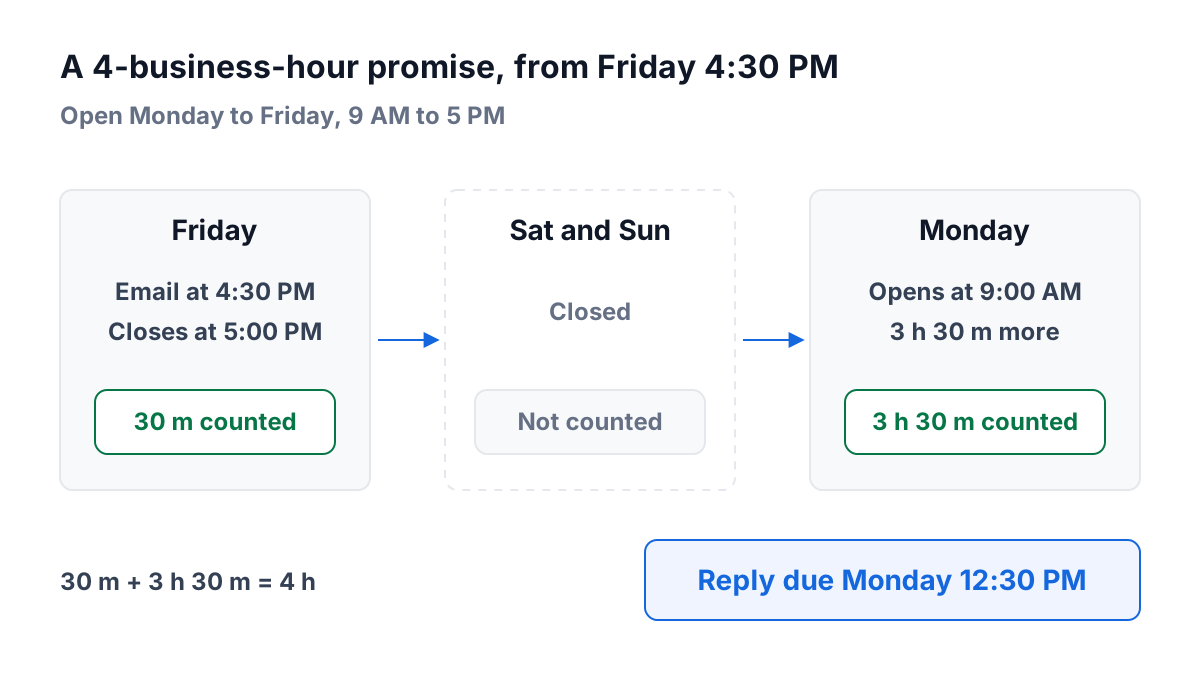
Friday, 4:30 PM. Carla, a client, writes in: her contact form has stopped sending messages. The first-reply clock starts. There are 30 minutes of business hours left on Friday, so 30 minutes count. At 5 PM the clock stops with 3 hours 30 minutes still to run.
Saturday and Sunday. The agency is closed. Nothing counts.
Monday, 9:00 AM. The clock starts again. 3 hours 30 minutes from 9 AM is 12:30 PM. That is when Carla’s first reply is due. From 11:30 AM it is due soon.
| Day | Business hours counted | Still to run |
|---|---|---|
| Friday, 4:30 to 5:00 PM | 30 minutes | 3 h 30 m |
| Saturday, Sunday | none (closed) | 3 h 30 m |
| Monday, 9:00 AM to 12:30 PM | 3 h 30 m | due at 12:30 PM |
Monday, 10:15 AM. Ben owns the case. He checks the form, finds that the mail setting expired, and replies: he has seen the problem, he is fixing it today, and he will write again by 3 PM. The first target is met with over two hours to spare.
Monday, 2:00 PM. Before Ben writes again, Carla replies with a screenshot of a second form that is broken too. A new wait starts. The next-reply target is 8 business hours: 3 hours run on Monday until 5 PM, and the other 5 run from 9 AM Tuesday. Her next reply is due Tuesday at 2:00 PM.
Ben fixes both forms by 2:45 PM Monday and writes to say so. Both targets were met, and no one had to stay late on Friday to keep them.
Notice what the business hours did. Without them, a four-hour target would have been missed at 8:30 PM on Friday, and the team would have learned to ignore the number.
How to measure it
You do not need a report to start. Once a week, look at the cases you answered and ask one question of each: did the reply go out before it was due? Count the ones that did not, and read them. You will usually find the same cause again and again: a case no one owned, a thread that looked old, a question no one could answer alone.
Fix the cause, not the clock. If you keep missing the target for good reasons, change the target, and tell your customers the new one. For the habits that stop cases slipping in the first place, see how a small team should handle support email.
How ContactRoll does it
In ContactRoll, your business hours are set for each weekday, in your organization’s time zone, along with a target: a first response within so many business hours and each next reply within so many, each with its own “due soon” point. A product can have a target of its own. Every case in the queue carries a chip in words, such as “Reply in 3 h 20 m”, counted only inside your business hours. It turns yellow when the case is due soon and reads “Overdue 12 m” once the target is missed, so the words carry the state as well as the color. You can start free, with no card.
Questions
What is a good email response time for a small business?
The one you set and keep. Choose a first-reply target in business hours, such as four, that your team can meet on a busy day, and measure every case against it.
Do weekends count toward an email response time?
Only if you are open on weekends. Count the target in business hours, so time when the team is closed does not count against it.
Does a reply that says “we’re looking into it” count?
Yes, if it is honest and useful: it confirms the problem, says what happens next and when the customer will hear again. It stops the first clock and starts a commitment you must keep.