Guide
How to set up sales pipeline stages for a small team
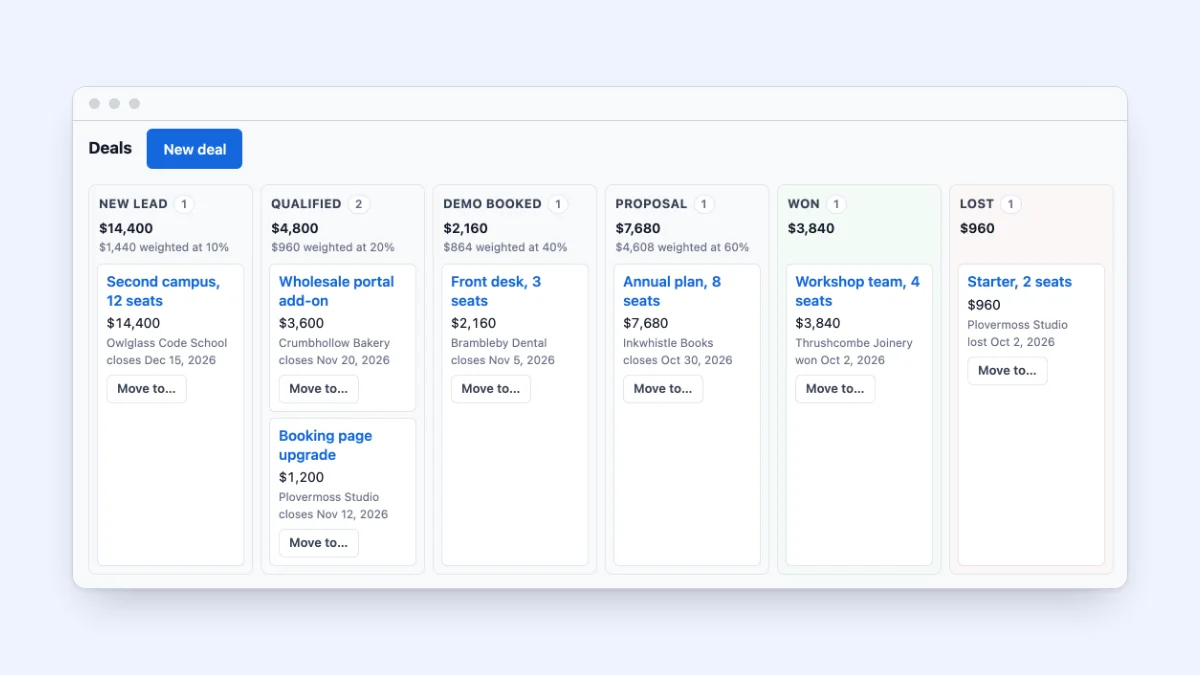
Most small teams copy their pipeline stages from a template, such as Prospect, Contacted, Demo and Negotiation, and within a month nobody trusts the board. Deals sit in “Negotiation” for weeks, nobody agrees on what “Qualified” means, and the total at the bottom is a number nobody plans with.
This guide sets out a method that works in a spreadsheet or in any CRM: stages named after what the customer has done, a rule for leaving each one, a chance of winning for each, and a short weekly review. Then it follows three deals at an invented firm through one month.
What a pipeline is for at this size
In a team of 10 to 25 people, a pipeline has two jobs. It tells you what is likely to close, and roughly when, so you can plan cash, hiring and how much work to take on. And it tells you which deals need a nudge this week. It is not a report for its own sake, so judge every stage, field and habit below by whether it helps with one of those two jobs, and leave out what does not.
Name each stage after what the customer has done
Most stage names describe what the seller did: Contacted, Proposal sent, Followed up. They show how busy you were, not whether the deal moved: a deal can sit in “Proposal sent” for two months after the customer stopped reading your email.
Name each stage after something the customer has done that you can check: “Asked for a quote” rather than “Contacted”, and “Booked a walkthrough” rather than “Meeting scheduled”. The customer either did it or did not, so two people looking at one deal put it in the same place. And your work only shows that you want the deal; the customer’s shows that they might buy.
Five or six open stages, plus Won and Lost
Five or six open stages are enough for most small teams, plus Won and Lost. With fewer, one stage holds deals that are nowhere near each other; with more, people argue about where a deal belongs. If two stages are always passed in the same week, merge them. If one holds half your deals for months, split it where customers really stop.
Write one exit rule for each stage
For every open stage, write one sentence saying what must be true before a deal leaves it: “A deal leaves Booked a walkthrough once the customer, after the visit, has told us their budget and move-in date.” Tie it to something you can point to, such as an email, a calendar date or a signed page.
The exit rule is what keeps a pipeline honest. Without it, a deal moves when its owner feels good about it; with it, anyone can look at a deal and say whether it belongs where it is.
Give each stage a chance of winning
Each open stage gets a chance of winning: of the deals that reach it, the share that end up won. If you have last year’s deals, count them. If not, start with a guess that rises through the stages, such as 10%, 20%, 40%, 60% and 80%, and correct it after a quarter. Won and Lost need no chance: a won deal is money won, and a lost one counts for nothing.
The weighted total is each open deal’s amount multiplied by its stage’s chance, added up. A $50,000 deal in a 40% stage counts as $20,000, and a $10,000 deal in an 80% stage as $8,000: $60,000 in full, $28,000 weighted.
It is a better guess than the full amounts, because each deal counts in proportion to how far it has gone, but with a dozen deals one large one moves it a lot, so read it as a trend from week to week. Give every deal an expected close date too, so you can see which month the money should land in.
An example set of stages
Here is a set for a business that sells projects, such as office renovations. The worked example below uses it.
| Stage | A deal leaves it when | Chance of winning |
|---|---|---|
| Asked for a quote | They agree to a date for a walkthrough | 10% |
| Booked a walkthrough | After it, they tell us their budget and move-in date | 20% |
| Shared a budget and a date | They have gone over our written proposal with us | 40% |
| Went over our proposal | They ask for the contract | 60% |
| Asked for the contract | The contract is signed and the deposit paid | 80% |
| Won | Closed | Counted as money won |
| Lost | Closed, always with a reason | Counts for nothing |
Record why every lost deal was lost
When a deal is lost, write down why, every time. Pick from a short list you can count, such as price, timing, chose someone else, no budget and went quiet, and add a sentence when the list is not enough. After a quarter, the reasons tell you what to change: if most say price, look at how you quote; if deals go quiet after the proposal, look at the week after you send one.
Close dead deals as lost rather than leaving them open. A deal nobody believes in still counts in the weighted total.
Give every open deal an owner, a next step and a task
Every open deal needs one owner and one next step with a date: “Call Rosamund on Thursday to ask whether the board approved the budget.” Put that step on the deal as a task due that day, so it reaches the owner’s list instead of living in their head.
A deal with no next step is waiting for the customer to remember you, and a deal with two owners is one each thinks the other is handling. The same owner can also be the person a customer’s calls reach first; see how to route calls to the customer’s account owner.
Review the pipeline for 15 minutes a week
Once a week, everyone who owns deals looks at the pipeline together. With the rules above in place, fifteen minutes is enough:
- Deals with no next step, or one in the past. Give each a new step and date, or close it as lost with a reason.
- Each stage, nearest a signature first. Move what met its exit rule, and move back anything that moved without meeting it.
- Close dates that have passed. Set a realistic new one, or close the deal.
- The totals. Write down the full total, the weighted total and what was won, beside last week’s.
If it takes longer, there are usually too many stages or too many dead deals.
One pipeline, or two
Keep one pipeline while every deal goes through the same steps. A second is worth having only when a kind of sale really takes different steps, such as renewals, which close in days and are nearly always won. Mixed in with new business, they would make every stage look likelier to win than it is for a new customer.
Do not make a pipeline per salesperson, region or product just to sort the board. An owner, a filter or a field does that without splitting your history.
A spreadsheet or pipeline software?
Everything above works in a spreadsheet, with a row per deal and a formula for the weighted total, and that suits one seller with a dozen deals. Software earns its place when several people own deals, when tasks should come due by themselves, and when a deal should sit beside the customer’s emails and calls. To choose one, use how to choose a CRM for a small team and the small-team CRM buying checklist.
A worked example: one month at Gorsewick Interiors
Gorsewick Interiors is an invented eight-person firm that designs and renovates offices for companies of 10 to 80 people. Imogen, who owns it, and Lucan, who prices the work, do the selling. It uses the stages in the table above, with chances Imogen took from last year’s deals: of the 30 that reached a walkthrough, 6 were won, so that stage is 20%.
Each Friday they spend fifteen minutes on the board. Here are three of its deals over one month; to keep the sums simple, the totals count only these three.
At the start, a staffing agency moving to a bigger floor has asked for a quote: $60,000 at 10%. An accounting firm wanting two meeting rooms and a reception has shared a budget and a date: $24,000 at 40%. A nonprofit refreshing its head office has booked a walkthrough: $40,000 at 20%. Weighted, that is $6,000 + $9,600 + $8,000 = $23,600.
Week 1. The agency agrees to a date for a walkthrough and moves up a stage. Imogen sends the accounting firm its proposal, and that deal stays put: sending is Gorsewick’s act, not the customer’s. Lucan walks the nonprofit’s office, but it cannot name a budget until its board meets at the end of the month, so that deal stays too, with a task for the day after.
Week 2. After its walkthrough, the agency shares a budget of about $60,000 and a March move-in. The accounting firm goes over the proposal with Imogen and drops one meeting room, which brings the price to $21,000.
Week 3. The agency goes over its proposal with Lucan. The accounting firm asks for the contract.
Week 4. The accounting firm signs and pays its deposit: $21,000 won. The agency asks to see a cheaper kitchen, so its deal stays put while Lucan revises the proposal. The nonprofit’s board sets no budget for the work this year, so Lucan closes it as lost, with the reason “No budget this year” and a task for March to ask again.
| End of | What changed | Weighted total |
|---|---|---|
| Start | Where the month begins | $23,600 |
| Week 1 | Agency to 20% | $29,600 |
| Week 2 | Agency to 40%; accounting firm to 60%, at $21,000 | $44,600 |
| Week 3 | Agency to 60%; accounting firm to 80% | $60,800 |
| Week 4 | Accounting firm won, $21,000; nonprofit lost | $36,000 |
Two things stand out. The weighted total fell in the best week of the month, because won and lost deals both leave the open pipeline: read it beside what was won. And the nonprofit sat at 20% all month. Without the exit rule, Lucan would have moved it up after the walkthrough, and for three weeks the total would have counted it at $16,000 instead of $8,000.
How ContactRoll does it
In ContactRoll, each deal has an owner, an amount, a stage and a close date. An Owner or Administrator names the stages, so each can say what the customer has done, and gives each open stage its chance of winning. A deal moves by dragging it across the board at a desk, or with a button that moves it to any stage, which also works from a keyboard and on a phone. Each stage shows what its deals add up to, and each open stage that total weighted by its chance of winning. A lost deal needs a reason, and every change of stage, amount, owner or close date is recorded with who made it and when, in a history nobody can edit. A task can sit on a deal, and each member’s task list sorts theirs into overdue, today and upcoming. Deals come with every plan, Free included, which has one pipeline (pricing). You can start free, with no card.
Questions
What stages should a small business sales pipeline have?
Five or six open stages, each named after something the customer has done, such as asking for a quote or booking a walkthrough, plus Won and Lost. Give each stage a one-sentence exit rule so everyone moves deals the same way.
How do you calculate a weighted pipeline?
Multiply each open deal’s amount by its stage’s chance of winning, then add up the results. A $50,000 deal in a stage where four in ten deals are won counts as $20,000.
How often should a small team review its sales pipeline?
Once a week, for about fifteen minutes. Give every deal without a next step a new one or close it with a reason, move what met its stage’s exit rule, and compare the weighted total with last week’s.